

The Symbolism of Serpents and Snakes in Antique Jewelry
Check back soon. New additions will be joining the collection.
The serpent is one of the oldest and most enduring symbols in the history of jewelry. Appearing in ornaments across ancient civilizations and later flourishing in Georgian and Victorian design, the snake carries a complex symbolic language associated with eternity, transformation, protection, and enduring love.
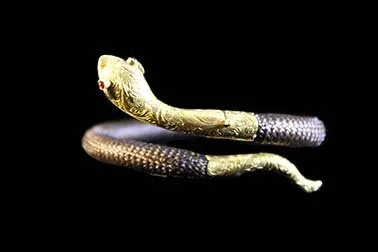
In antique jewelry, the serpent’s sinuous form allowed goldsmiths to create pieces that were both visually striking and deeply meaningful. Coiled rings, bracelets that wrapped around the wrist, and necklaces shaped as serpents were not merely decorative objects—they conveyed powerful ideas about life, loyalty, and renewal.
Ancient Origins of the Serpent Symbol
The symbolism of serpents stretches back thousands of years. In ancient Egypt, serpents represented divine protection and sovereignty. The uraeus, a rearing cobra worn on royal crowns, symbolized the protective power of the gods.
In Greek and Roman culture, snakes were linked to healing and rebirth. The serpent entwined around the staff of Asclepius, the god of medicine, remains a symbol of healing to this day. Because snakes shed their skin and emerge renewed, they naturally became associated with regeneration and transformation.
These early meanings laid the foundation for the serpent’s later appearance in European jewelry.
The Serpent as a Symbol of Eternity
Perhaps the most enduring symbolism of the snake in jewelry relates to eternity and the infinite cycle of life. When depicted biting its own tail—a form known as the Ouroboros—the serpent forms a perfect circle, representing existence without beginning or end.
Even when not shown in the ouroboros form, the snake’s coiled body naturally evokes continuity and perpetual motion. For this reason, serpent rings and bracelets often symbolized eternal bonds between individuals, particularly in romantic contexts.
Serpent Jewelry in the Victorian Era
Serpent jewelry reached extraordinary popularity during the nineteenth century, particularly in the Victorian period. The motif gained widespread attention after Queen Victoria received a serpent engagement ring from Prince Albert in 1839.
The ring featured a coiled snake set with an emerald—Victoria’s birthstone—representing eternal love and wisdom. Following this royal association, serpent motifs became fashionable throughout Europe and America.
Victorian serpent jewelry frequently appeared as:
Coiled snake rings, symbolizing eternal devotion
Bracelets that wrapped around the wrist, representing protection and unity
Necklaces and brooches, sometimes set with gemstone eyes
The fluid form of the snake allowed jewelers to create dynamic designs that seemed almost alive.
Transformation and Renewal
Because snakes shed their skin, they have long been associated with renewal and transformation. This symbolism resonated strongly during the Victorian era, when jewelry often conveyed messages of emotional resilience, remembrance, and spiritual reflection.
A serpent jewel could therefore symbolize not only love but also personal renewal and the cyclical nature of life.
Protection and Guardianship
In many cultural traditions, serpents were believed to possess protective qualities. Ancient myths often portrayed snakes as guardians of sacred spaces, treasures, or hidden knowledge.
When incorporated into jewelry, the coiled serpent could symbolize watchfulness and guardianship, suggesting that the wearer was under the protection of the creature’s vigilant gaze.
A Motif of Mystery and Power
Today, antique serpent jewelry continues to captivate collectors and historians alike. Its symbolism is layered and multifaceted—combining themes of eternity, wisdom, protection, and rebirth within a single elegant form.
Unlike many decorative motifs that fall in and out of fashion, the serpent has remained continuously present in jewelry for millennia. Its enduring appeal lies in the powerful ideas it represents: life’s cycles, love’s continuity, and the quiet mystery of transformation.
For collectors of antique jewelry, serpent motifs offer a rare intersection of symbolism, craftsmanship, and cultural history—objects in which gold has been shaped into one of humanity’s oldest and most meaningful symbols.