

Hallmarks in Antique Jewelry
A Collector’s Guide to Gold Marks and Their Meaning
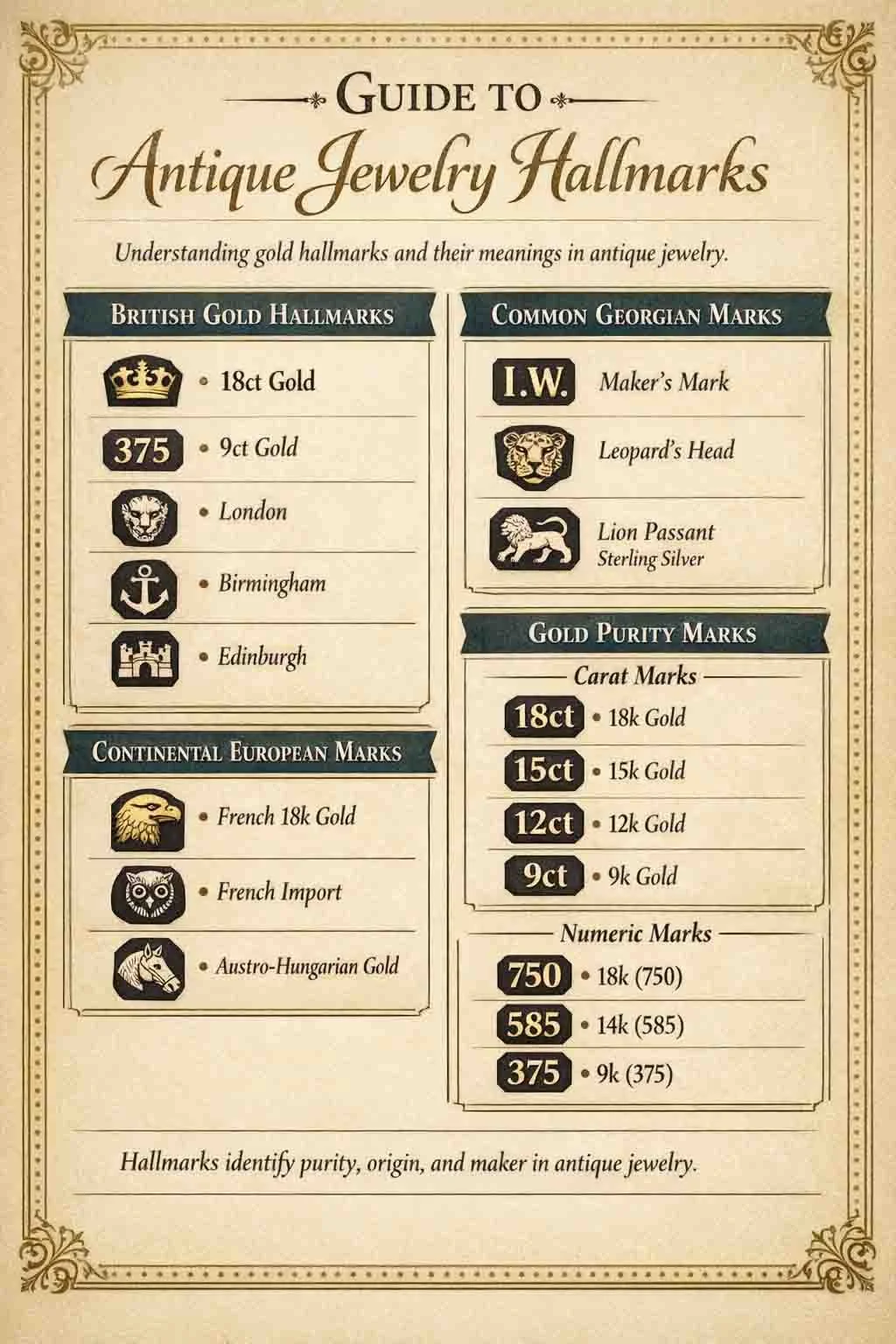
For collectors of antique jewelry, hallmarks function as a quiet language stamped into gold and silver—tiny symbols that reveal a piece’s origin, composition, and sometimes even the precise year it was assayed.
Long before modern brand signatures became common, governments required precious metal objects to be officially tested for purity. After testing, the piece was stamped with identifying marks. These stamps—known collectively as hallmarks—remain one of the most valuable tools for authenticating antique jewelry today.
For historians and collectors, hallmarks are not merely regulatory marks; they are fragments of documentary history preserved in gold.
What Hallmarks Are
A hallmark is an official mark applied to precious metal to certify its purity and authenticity. The term originates from Goldsmiths’ Hall in London, where metals were historically tested and stamped beginning in the medieval period. A complete hallmark system traditionally includes several marks, each conveying different information about the object:
• Purity mark – indicates the gold or silver content
• Assay office mark – identifies where the metal was tested
• Maker’s mark – identifies the workshop or goldsmith
• Date letter – indicates the year the item was hallmarked
• Duty mark (historically) – indicated that taxes had been paid on the metal
These marks allowed governments to regulate precious metals while simultaneously protecting consumers from fraud.
For modern collectors, hallmarks provide clues that can confirm:
• authenticity
• country of origin
• approximate age
• metal purity
• sometimes the individual maker
Because hallmarks were regulated and documented, they are often more reliable than stylistic dating alone.
Common Victorian Hallmarks
The Victorian era (1837–1901) coincided with the height of formal hallmark regulation in Britain. Jewelry produced during this period frequently carries highly standardized marks.
Victorian hallmarks often appear in small grouped stamps on the interior of rings, the reverse of brooches, or the clasp of bracelets.
Common British Victorian hallmarks include:
Crown mark
Traditionally associated with 18-carat gold.
18, 15, 12, or 9 numerical marks
These indicate the carat purity of gold.
Victorian Britain used several gold standards:
• 18 carat gold – high jewelry standard
• 15 carat gold – common in mid-Victorian pieces
• 12 carat gold – sometimes used for lockets or chains
• 9 carat gold – widely used in later Victorian jewelry
Assay office symbols
Examples include:
• Leopard’s head – London
• Anchor – Birmingham
• Crown – Sheffield
• Castle – Edinburgh
Date letters
Each assay office used a sequence of letters corresponding to specific years. When paired with the office mark, these letters allow precise dating of a piece.
Because Victorian jewelry was heavily regulated, pieces with intact hallmarks can often be dated to a single year of manufacture.
Common Georgian Hallmarks
Jewelry from the Georgian period (1714–1837) often displays earlier forms of hallmarking.
However, Georgian hallmarks are less consistently preserved because:
• jewelry was often handmade and repaired repeatedly
• thin metal pieces were polished over time
• small objects sometimes escaped hallmark requirements
Typical Georgian marks may include:
Maker’s mark
Usually the earliest mark applied. Georgian maker’s marks often consist of initials inside a shaped cartouche.
Assay office symbol
Similar to Victorian marks but sometimes appearing in earlier forms.
Examples:
• London leopard’s head
• Birmingham anchor
• Sheffield crown
Standard mark
Indicates the purity of the metal.
Common examples include:
• Crown for 18-carat gold
• Lion passant for sterling silver
Because Georgian marks may be partially worn or incomplete, authentication often requires comparing several features:
• hallmark style
• engraving technique
• construction methods
• gemstone cuts
For this reason, Georgian jewelry often requires more specialized study than later Victorian pieces.
How Hallmarks Indicate Gold Purity
Gold purity refers to the percentage of gold within an alloy.
Pure gold is extremely soft, so it is almost always mixed with other metals such as copper or silver to improve durability.
The purity of gold is traditionally expressed in carats (karats).
The system divides gold into 24 parts:
Carat Gold Content24k100% gold22k91.6% gold18k75% gold15k62.5% gold14k58.5% gold12k50% gold9k37.5% gold
Victorian British jewelry frequently used 15k, 18k, and 9k gold, while continental European jewelry more commonly used 18k and 14k.
Modern numeric purity marks sometimes appear as three-digit numbers representing gold content per thousand parts:
StampMeaning75018k gold58514k gold3759k gold
These marks became more standardized in the late 19th and early 20th centuries, particularly across Europe.
Examples of Hallmark Stamps
Collectors commonly encounter several hallmark formats in antique jewelry.
Below are some of the most frequently seen marks.
British Gold Hallmarks
• Crown + 18
18-carat gold (Victorian standard)
• 375
9-carat gold
• Leopard’s Head
London assay office
• Anchor
Birmingham assay office
• Castle
Edinburgh assay office
Continental European Hallmarks
Many European countries adopted national symbols indicating gold purity.
Examples include:
• Eagle’s head (France) – 18k gold
• Owl mark (France) – imported gold items
• Horse head (Austria-Hungary) – gold standard mark
Continental hallmarks are often accompanied by maker’s initials stamped within small geometric frames.
Maker’s Marks
Maker’s marks identify the goldsmith or workshop that produced the piece.
Examples may appear as:
• two or three initials
• symbols within shields or cartouches
• registered workshop stamps
For collectors, maker’s marks can sometimes be traced to specific goldsmiths recorded in historical assay registers.
This makes them invaluable in establishing provenance.
Why Hallmarks Matter to Collectors
Hallmarks provide a rare combination of historical documentation and physical evidence embedded directly in the object.
They can confirm:
• the metal composition
• the country of manufacture
• the approximate age
• sometimes the exact workshop
For antique jewelry collectors, these tiny stamps transform an object from simply decorative ornament into a documented historical artifact.
In this way, hallmarks function as a bridge between artistry and historical record, allowing each piece of antique jewelry to carry its own small archive within the metal itself