

Ancient Symbol of Serpent Swallowing its own Tail - Endless
Check back soon to see new additions to our Collection.
I am currently sourcing unique historical pieces from reputable European Auction Houses.
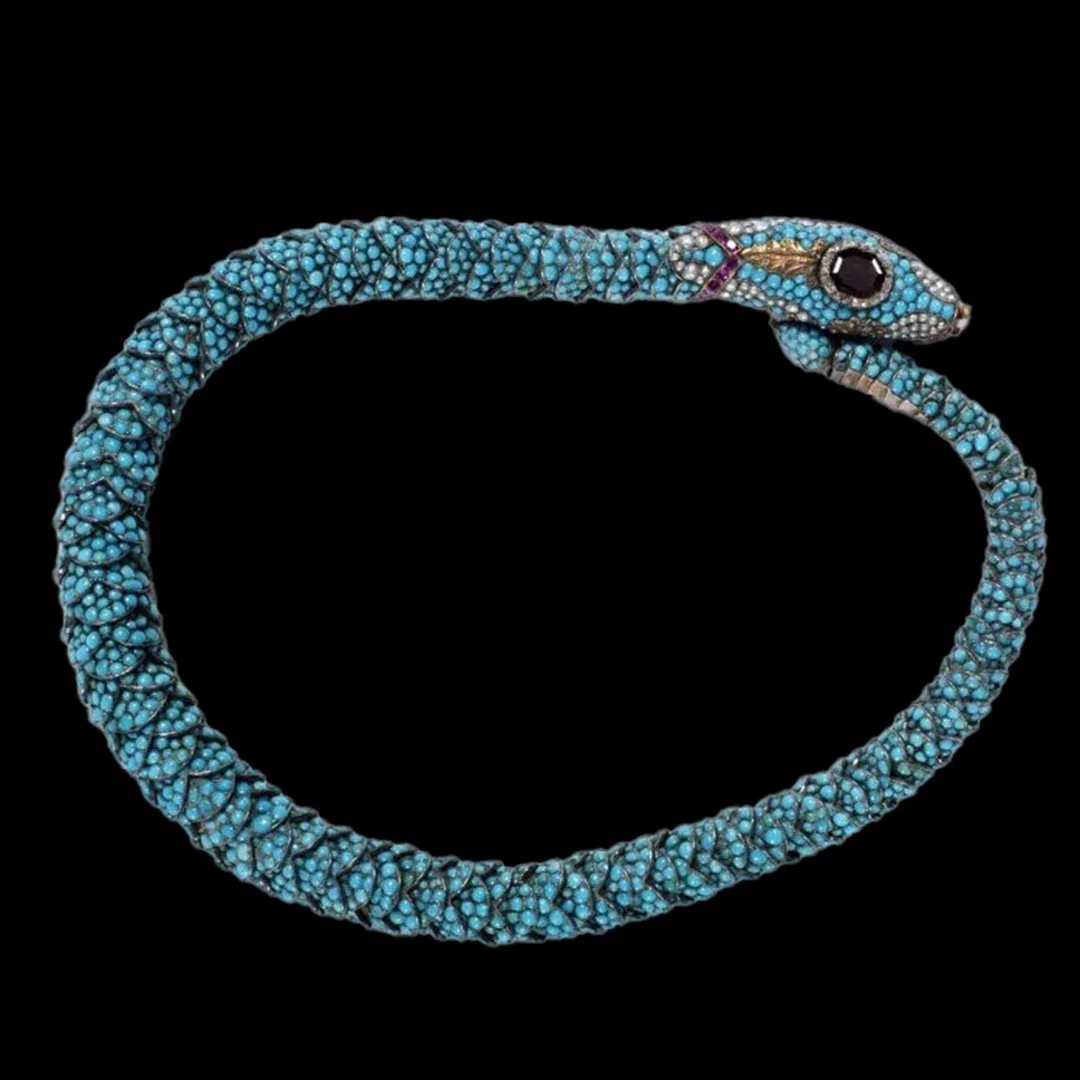
The ouroboros, a serpent swallowing its own tail, is one of the most ancient and enduring symbols in human history. Appearing in mythology, philosophy, and decorative arts across civilizations, the ouroboros represents eternity, renewal, and the cyclical nature of existence. In jewelry, the motif transforms this philosophical idea into a wearable emblem of continuity—an unbroken circle symbolizing life without beginning or end.
When fashioned in gold, the ouroboros becomes both ornament and allegory, expressing the timeless relationship between life, death, and rebirth.
Origins of the Ouroboros Symbol
The earliest known depictions of the ouroboros appear in ancient Egyptian funerary texts, where the serpent encircles the sun god, symbolizing the eternal cycle of creation and destruction. The image later spread through Greek philosophical traditions, where it became associated with the idea that the universe continually renews itself.
The Greek name ouroboros derives from oura (tail) and boros (devouring), literally meaning “tail-eater.” This paradoxical image—life consuming itself to sustain existence—became a powerful metaphor for infinity.
Through the centuries, the symbol was adopted in alchemy, Hermetic philosophy, and early scientific thought, where it represented the unity of opposing forces and the perpetual transformation of matter.
The Ouroboros in Jewelry
The circular form of the ouroboros naturally lends itself to jewelry design. Rings, bracelets, and pendants often depict a serpent whose head meets its tail, forming a perfect and continuous loop.
In the nineteenth century, serpent jewelry gained enormous popularity, particularly during the Victorian era, when symbolic jewelry flourished. The ouroboros became associated with themes of:
Eternal love
Unending loyalty
Rebirth and renewal
The infinite cycle of life
These meanings made the motif especially suitable for engagement rings, mourning jewelry, and sentimental tokens.
Symbolism of the Serpent
The serpent itself carries complex symbolism across cultures. In many traditions, snakes represent transformation because they shed their skin and emerge renewed. This natural cycle of regeneration aligns closely with the philosophical meaning of the ouroboros.
Within jewelry, the serpent therefore embodies several interconnected ideas:
Immortality and eternity
Transformation and rebirth
Protection and guardianship
Wisdom and ancient knowledge
When the serpent forms a circle, these meanings intensify, reinforcing the concept of endless continuity.
Ouroboros and the Idea of Infinity
Long before the modern infinity symbol became widely used, the ouroboros served as one of humanity’s earliest visual representations of infinity. Its circular form suggests that endings and beginnings are part of the same continuous process.
For this reason, ouroboros jewelry often carries a philosophical dimension. The design quietly acknowledges the passage of time while also affirming the persistence of life, memory, and love.
A Symbol Across Civilizations
Few symbols have traveled as widely through human culture as the ouroboros. From ancient Egypt to classical Greece, from medieval alchemy to Victorian jewelry, the image has remained remarkably consistent.
Each generation has reinterpreted the symbol according to its own beliefs, yet its essential meaning endures: the universe is cyclical, and existence continually renews itself.
In jewelry, the ouroboros becomes a poetic expression of that idea—an eternal circle of gold, reminding the wearer that life, transformation, and continuity are inseparable parts of the human story.