How Do I Love Thee? — Counted in Gold / Regency Bracelet
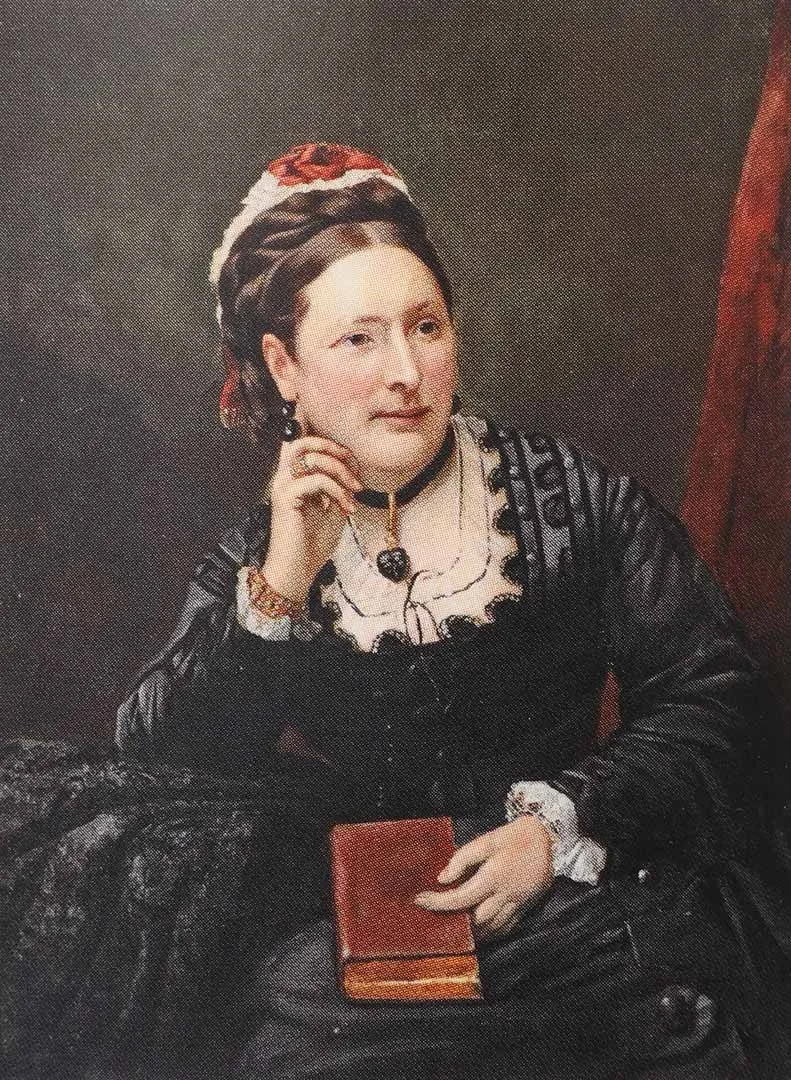
Amelia Moulton-Barrett, sister-in-law of Elizabeth, wearing the bracelet, circa 1860
Elizabeth Barrett Browning’s How Do I Love Thee? is often read as a triumph of abstraction: love measured not by possessions but by spiritual reach — “the depth and breadth and height / My soul can reach.” Yet before the poem ever existed, love in the Barrett household had already been counted—quietly, materially, and with exquisite care — through hair, initials, and gold.
The Regency gold hairwork bracelet made for Mary Moulton-Barrett, Elizabeth’s mother, is not a metaphor for love. It is love, rendered durable. Each panel contains a lock of a child’s hair, preserved beneath glass and engraved with an initial: Elizabeth among her siblings, each named without words, each present without speech. This is love that does not argue its magnitude. It arranges itself in sequence. It keeps vigil.
In the poem, Barrett Browning insists on measurement while denying its limits. She counts love the way a soul counts—by reach, by necessity, by moral gravity. The bracelet answers with a different arithmetic: nine children, nine panels, a circumference sized to the wrist that once bore them daily. Love here is neither infinite nor abstract. It is enumerated, and therefore unforgettable.
Love “to the level of every day’s / Most quiet need”
Hairwork was never meant for spectacle. It belongs to the domestic register—objects worn close to the body, understood by those who shared a household or a grief. The turquoise cabochons at each corner—stones long associated with affection and protection—do not sparkle so much as anchor the composition. Their blue punctuates the gold the way breath punctuates a sentence.
This bracelet would have rested against Mary Moulton-Barrett’s pulse as she moved through her days: supervising lessons, managing a household, mothering a future poet. It is love made habitual. Not exalted, but constant.
In the poem, Barrett Browning declares her love “to the level of every day’s / Most quiet need, by sun and candle-light.” The bracelet exists entirely in that register. It does not aspire upward. It stays with the body. It keeps time with the wrist.
“I love thee freely… purely… with the breath, smiles, tears, of all my life”
There is something radical in the bracelet’s refusal to prioritize hierarchy. No child’s panel dominates. The hinges grant each compartment independence and cohesion—an architecture of equality. This is maternal love without favoritism, engraved but not ranked.
Barrett Browning’s sonnet moves through similar moral terrain. Her love is freely given, purely offered, uncorrupted by praise or display. It is cumulative rather than competitive—breath layered upon breath, grief folded into faith.
The bracelet, too, is cumulative. Each lock of hair was added not at once, but over time, as children arrived into the world. Love here accrues. It does not replace. It expands.
Love after death
The poem’s final vow—“and, if God choose, / I shall but love thee better after death”—often reads as a metaphysical leap. But the bracelet reveals that Elizabeth Barrett Browning was raised inside a culture already fluent in loving beyond mortality. Hairwork was a technology of endurance. It allowed the living to keep part of the beloved when bodies changed, aged, or disappeared.
This bracelet survived its wearer. It survived the poet’s childhood. It survived the century that named her immortal. Love did, in fact, continue after death—held in gold, passed by descent, confirmed by portraiture, and now re-encountered by new eyes.
Counted, not exhausted
How Do I Love Thee? is a poem that counts love without exhausting it. The bracelet does the same. Each panel is finite. The circle is complete. And yet what it contains exceeds what can be seen: a household, a lineage, a future voice that would teach the world how to speak love aloud.
Together, poem and bracelet form a single sentence written across mediums—one in language, one in gold. Both insist on the same truth: love may be measured, but it is never diminished by being named.
It endures because it was counted carefully.